Article Summary
This article explores the ancient Chinese ritual of burning three incense sticks. From Buddhist symbolism to Taoist cosmology and Confucian self-reflection, the practice carries deep cultural meaning that has endured for over two thousand years. We explain why three — not one, not four — and what this number represents across different traditions.
Introduction
If you have ever visited a Chinese temple, a traditional home altar, or even watched a Chinese movie, you may have noticed a consistent detail: people almost always burn three incense sticks. Not one, not four, not a handful — always three.
Why?
The answer is not simple. Depending on whether you ask a Confucian scholar, a Buddhist monk, or a Taoist priest, you will get a different explanation. But all of them point to the same underlying idea: three is a number of completeness.
The Confucian View: Three Mindsets for Self-Reflection
In Confucian-influenced folk tradition, the three sticks represent three states of mind:
1.戒香 (Jiè Xiāng) — The Incense of Discipline
This stick reminds the burner to reflect on their own actions. Have I been loyal to my duties? Have I been trustworthy with my friends? Have I practiced what I have learned? It is a moment of honest self-examination before making any request.
2.定香 (Dìng Xiāng) — The Incense of Stillness
This stick calls for a calm and focused mind. If you approach the ritual with a restless heart or distracted thoughts, how can you expect your prayers to be heard? The act of burning incense becomes a practice of inner peace.
3.慧香 (Huì Xiāng) — The Incense of Wisdom
Once the mind is disciplined and still, you are ready to present your sincere wishes. This third stick is the bridge between your intention and the divine.
The Buddhist View: The Three Jewels
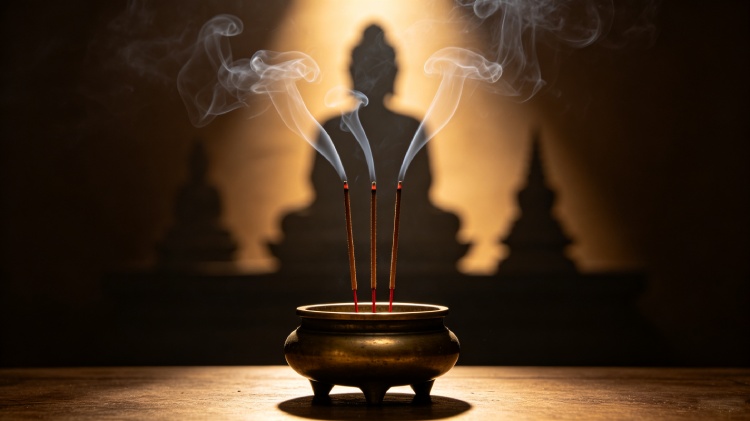
In Buddhism, the three sticks represent the Three Jewels (Triratna) — the core pillars of Buddhist practice:
The Buddha — the enlightened one, the teacher.
The Dharma — the teachings, the path, the universal law.
The Sangha — the community of practitioners who walk the path together.
When a Buddhist lights three sticks, they are not just making an offering. They are reaffirming their commitment to these three foundations. The order of lighting also matters: the middle stick is lit first for the Buddha, the right for the Dharma, and the left for the Sangha.
The Taoist View: Three Represents All Things
Taoism offers perhaps the most philosophical explanation. The ancient text Tao Te Ching says: “The Tao gives birth to One. One gives birth to Two. Two gives birth to Three. Three gives birth to all things.”
By burning three sticks, Taoists symbolically honor the entire universe — because three represents everything. In recent years, the Chinese Taoist Association has actively promoted “three-stick incense burning” as an environmentally conscious alternative to burning large piles of incense. Behind this lies a simple wisdom: only use what you need and to only need what the world can offer sustainably.
What About Ancestor Worship?
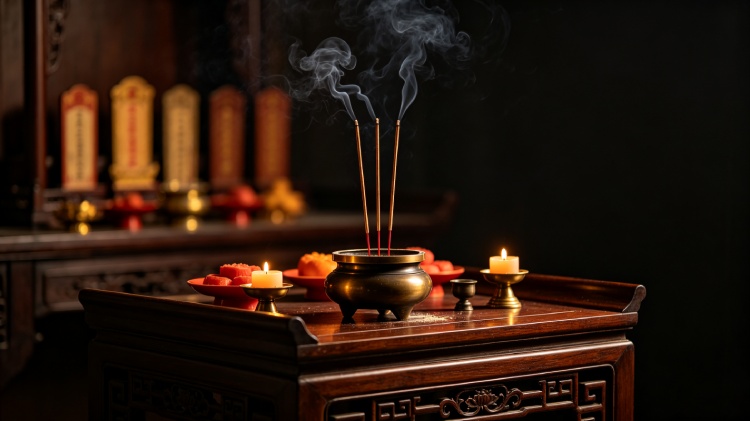
In many Chinese homes, three sticks are also burned when honoring ancestors. In this context, the three sticks represent three generations: grandparents, parents, and oneself — acknowledging the continuity of family across time.
The number three here is also a sign of respect and completeness. One stick may be enough for daily use, but for the ancestors who came before, three is the proper number.
So, Is Three Always the Rule?
Not necessarily. For daily home use, a single stick is perfectly fine. Three sticks are typically reserved for formal occasions: temple visits, festivals like Lunar New Year or Qingming, and ancestral ceremonies. The number three signals a higher level of respect and intentionality.
Conclusion
Understanding the meaning behind the ritual is one thing. But the quality of the incense itself matters just as much. In ancient times, only the finest natural ingredients — sandalwood, agarwood, and herbal blends — were considered worthy of such rituals.
Whether you are lighting one stick for daily meditation or three for a special ceremony, you are participating in a tradition that has been practiced for over two thousand years — a quiet conversation between the human and the divine, carried on a thread of fragrant smoke.
FAQ
Q1: Why do Chinese burn three incense sticks?
Three sticks represent the Buddha, Dharma, and Sangha in Buddhism; Heaven, Earth, and Humanity in Taoism; and three generations in ancestor worship. It symbolizes completeness and respect.
Q2: Can I burn just one incense stick?
Yes — one stick is perfectly fine for daily home use. Three sticks are typically reserved for formal occasions and temple visits.
Q3: What is the correct order for lighting three incense sticks?
In Buddhist tradition, the middle stick is lit first for the Buddha, then the right for the Dharma, and finally the left for the Sangha.
Q4: Does the number three have a special meaning in Chinese culture?
Yes — three is a powerful number in Chinese cosmology, representing the harmony of Heaven, Earth, and Humanity, and is seen as the number from which all things originate.
Related Products
Five Gods of Wealth Bamboo-Core Incense Sticks Set – 100% Natural Herbal Blends for daily meditation, available for wholesale and private label. [View product ]
Incense Gift Sets – Perfect for cultural appreciation and personal use. [View product ]
About Kuanggu Incense
Kuanggu Incense was founded in 2021 in Quanzhou, Fujian — the starting point of the Maritime Silk Road. We are rooted in China's Incense Capital, where over 1,000 years of incense-making heritage, 300+ enterprises, and US$2.1 billion in annual output value make us a trusted source for premium natural incense.
We offer incense sticks, cones, coils, innovative incense products , and other accessories — fully customizable — with private label, OEM, ODM and flexible MOQ for brands worldwide.
More than a supplier, we are inheritors of Chinese incense culture, blending ancient wisdom with modern quality to bring Eastern fragrance to the global market.
Ready to bring quality incense to your product line? [Contact us ]