Most older room thermostats use a very basic rule. They blast the heat at full power when it gets cold, then shut off entirely when the room hits the target temperature. We call this "bang-bang" control. It might work for older setups, but it usually leaves people feeling frustrated due to constant temperature swings.
Think about what happens when a boiler or heating element actually turns off. The stored heat inside your radiant floor or radiators doesn't just vanish. It keeps leaking into the room. This effect is known as thermal inertia. Because of it, the room gets much warmer than you actually wanted. Then, the room cools down. The system waits too long to kick back on, dropping the temperature too low. You end up riding a continuous roller-coaster of hot and cold.
Modern Heating Control Solutions fix this hysteresis issue using smarter software. Specifically, they use Pulse Width Modulation (PWM) paired with a Proportional-Integral-Derivative (PID) algorithm.
E-TOP has integrated PID and PWM algorithms into our digital thermostat firmware for over a decade. You will find this advanced control logic actively working across our WiFi thermostats, underfloor heating controllers, and boiler thermostats.
The Limitations of 0/100% Mechanical Relay Control
Mechanical thermostats basically act as dumb switches. They either give you 0% power or 100% power. There is no middle ground. If you run an electric underfloor heating mat or a hydronic radiator loop this way, you run into severe issues:
- Thermal Overshoot: The room continues heating long after the relay opens. This wastes energy and makes rooms feel stuffy.
- Equipment Damage & Fatigue: Constant mechanical switching under heavy electrical loads wears out relays fast. More importantly, hitting the boiler with abrupt 100% load requests causes thermal shock, shortening the lifespan of expensive HVAC components.
- Energy Waste: Repeatedly forcing a system to run at maximum capacity burns far more energy than holding a steady, low-level output.
How PWM and PID Work Together for Precision Control
How do we actually solve this? We replace crude on/off switching with predictive energy delivery.
1. PWM (Pulse Width Modulation)
PWM breaks the heating timeline into fixed cycles, like a 10-minute window. The thermostat then adjusts how long the heat actually stays on during that window. We call this the duty cycle. Let's say a room only needs a little heat. The thermostat turns on for 2 minutes and rests for 8 minutes. That is a 20% duty cycle. It simulates variable power output, but you don't have to buy expensive inverter hardware to get it.
2. The PID Algorithm
The PID algorithm acts as the brain. It constantly calculates the exact duty cycle needed for every PWM period:
- Proportional (P): Measures the current temperature gap. The further the room temperature is from the setpoint, the longer the active heating pulse.
- Integral (I): Tracks historical temperature error over time. If the room lingers 0.5°C below target for too long, the integral term gradually boosts the power output to close the remaining gap.
- Derivative (D): Monitors the rate of temperature change. If the room is heating up too quickly, the derivative term reduces the active duty cycle in advance. This prevents thermal overshoot before it even happens.
Field Performance: Equipment Protection & Perfect Comfort
When testing heating performance on a data logger, the difference between legacy control and PID/PWM modulation is immediately clear.
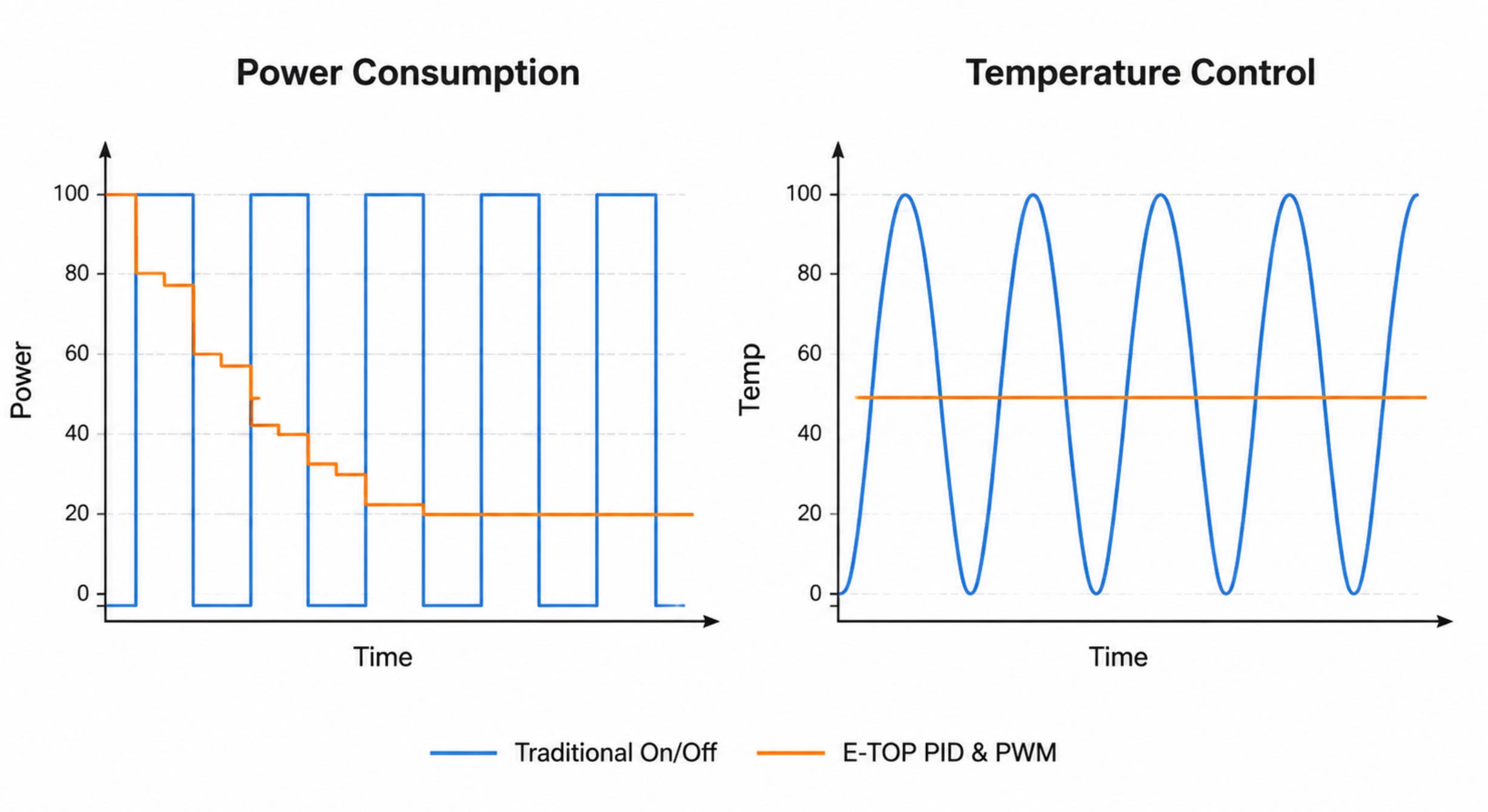
- Traditional On/Off Systems: The temperature graph displays a continuous sine wave pattern. It constantly fluctuates up to ±2°C around your target setpoint.
- E-TOP PID Control Systems: The initial heating phase ramps up smoothly. As the temperature approaches the setpoint, the power output steps down incrementally. Once stabilized, the room temperature holds in a perfectly flat line within ±0.2°C of the setpoint.
The Ultimate Benefit: By gently modulating the duty cycle instead of aggressively turning the heating loop fully on and off, the PID algorithm significantly minimizes thermal stress on pipes, valves, and heating elements. This translates to massive energy savings and greatly extended equipment lifespans.
Customizing PID Logic for OEM/ODM Partners
Every building reacts differently to heat. A thick concrete floor warms up much slower than a lightweight aluminum fan coil.
Through our Thermostat OEM & ODM Solutions, E-TOP customizes the firmware for global HVAC brands. Our R&D team adjusts the proportional bands, integral timers, and PWM limits. We match the exact thermal dynamics of your specific hardware. This ensures the thermostats perform flawlessly on the job site right out of the box.
Work with a Compliance-Ready Supplier
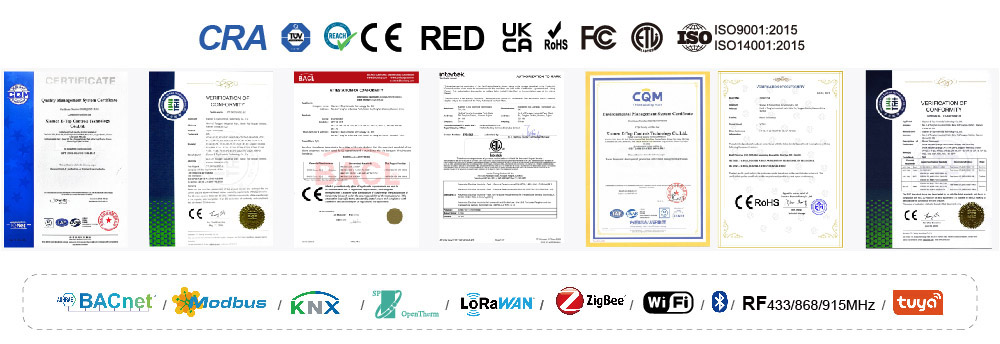
At E-TOP, compliance is built into our product development process from the start. Our wireless and smart thermostats are tested according to EU requirements, and we provide complete documentation for importer verification. We've worked with customers across multiple European markets, and our products have passed compliance checks with documentation reviewed by accredited labs.
To learn more about our engineering capabilities, you can explore our full range of HVAC heating control solutions.

Frequently Asked Questions (FAQ)
Q1: What is the main difference between hysteresis control and PID control in a thermostat?
A: Hysteresis (On/Off) waits for the room to cross a strict high or low limit before blasting the system at 100%. This creates annoying temperature swings. PID control constantly calculates the temperature error and the rate of change. It adjusts the heat output dynamically to maintain a flat, comfortable temperature line.
Q2: Does PWM control require special variable-speed heating equipment?
A: No special equipment is needed. PWM works perfectly with standard electric floor mats, thermal actuators, and regular boilers. It simply toggles the power on and off over a set time cycle. This simulates a variable output without needing any complex inverter technology.
Q3: How does a PID thermostat reduce energy consumption and protect equipment?
A: A PID thermostat prevents thermal overshoot, keeping the system from cooking the room past your setpoint. By stepping down power smoothly rather than using abrupt 100% bursts, it reduces thermal stress on boiler components and valves, saving energy while extending the lifespan of your HVAC equipment.