Article Summary
This article examines the health effects of burning incense — separating facts from common concerns. We explain the crucial difference between natural and synthetic incense, review what scientific research says about lung health and air quality, and provide practical tips for safe use. If you’ve ever wondered whether burning incense is good or bad for you, this guide offers clear, evidence-based answers.
Introduction
If you‘ve ever searched online about burning incense, you’ve probably seen two very different stories. One says incense is a wonderful tool for meditation, relaxation, and spiritual practice. The other warns about lung cancer, asthma, and indoor air pollution.
So which is it? Is burning incense good or bad for you?
The honest answer is: it depends entirely on what you burn.
The Problem Isn’t Incense. It‘s What’s In the Incense.
Most of the health concerns you‘ve read about — the studies linking incense smoke to respiratory issues, lung inflammation, and even cancer — are based on synthetic or low-quality incense. These products are often made with:
• Chemical binders (instead of plant-based gums)
• Synthetic fragrance oils (instead of natural botanicals)
• Artificial colorants (instead of natural plant pigments)
• Charcoal or chemical accelerants (to keep them burning)
When you burn these, you’re not just releasing fragrance. You‘re releasing particulate matter, volatile organic compounds (VOCs), carbon monoxide, formaldehyde, and polycyclic aromatic hydrocarbons (PAHs) — many of which are known irritants or carcinogens. Studies have shown that burning a single synthetic incense stick indoors can raise fine particulate concentrations above urban outdoor pollution levels.
This is where the “incense is bad for you” narrative comes from. And for good reason — synthetic incense absolutely can be harmful, especially with daily, long-term use in enclosed spaces.
The Other Side: Natural Incense Is a Different Story
Natural incense — made from pure wood powders, dried botanicals, essential oils, and plant-based binders — is a completely different product.
When you burn natural ingredients like sandalwood, agarwood, palo santo, or sage, the smoke contains far fewer harmful compounds. The fragrance comes from the plants themselves, not from synthetic oils dipped into charcoal blanks.
And here‘s what the research actually says about natural incense:
Stress Reduction & Mood Enhancement — Studies have shown that herbal incense containing agarwood, cinnamon, and star anise may offer protective effects against stress and memory impairment. The simple act of lighting incense and watching the smoke can lower cortisol levels and create a sense of calm.
Anxiety Relief — Research suggests that certain incense compounds interact with GABA receptors in the brain, which are associated with relaxation and reduced anxiety.
Anti-Inflammatory Properties — Agarwood incense smoke has been shown to exhibit anti-inflammatory activities in laboratory studies.
Meditation & Focus — For centuries, incense has been used to deepen concentration during meditation and prayer. The repetitive ritual of lighting a stick can serve as a mental anchor, signaling to your brain that it‘s time to slow down.
Space Cleansing — Many traditions use natural incense like white sage or palo santo to clear stagnant energy and create a fresh, peaceful atmosphere.
How to Tell Natural Incense from Synthetic
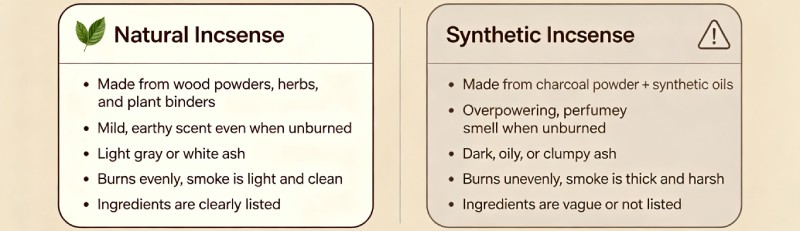
Not sure what you‘re burning? Here’s a quick checklist:
How to Burn Incense Safely (Whatever You Choose)
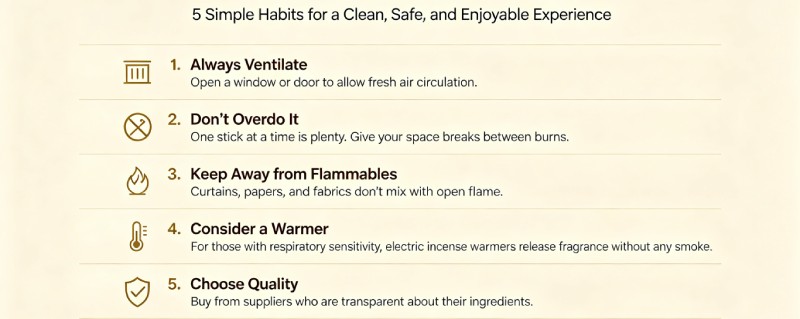
Even with natural incense, a few simple habits make a big difference:
The Bottom Line
Is burning incense good or bad for you?
Synthetic incense — the cheap, charcoal-based, perfume-dipped kind — carries real health risks that you should take seriously.
Natural incense — made from pure botanicals and plant-based binders — offers genuine benefits for relaxation, focus, and emotional wellbeing, with significantly lower risks when used mindfully.
The key is knowing what you‘re burning. And that’s exactly why we make our ingredients transparent.
Conclusion
Burning incense can be a healthy, enriching practice — but only if you choose the right product. Synthetic incense, made with chemical additives and artificial fragrances, poses real risks to lung health and indoor air quality. Natural incense, made from pure wood powders, herbs, and plant-based binders, offers a clean, authentic experience with significantly lower risks.
The choice is simple: read the label, choose natural, and always ventilate.
FAQ
Q1: Is incense ok for the lungs?
Natural incense, burned in moderation with proper ventilation, poses significantly lower risks than synthetic alternatives. Always choose natural ingredients and avoid prolonged exposure in enclosed spaces.
Q2: What is the healthiest incense to burn?
100% natural incense made from wood powders, resins, herbs, and plant-based binders — with no synthetic fragrances or chemical additives. Sandalwood and agarwood are excellent choices.
Q3: Is it okay to burn incense every day?
Yes — daily use is fine as long as you choose natural incense and burn it in a well-ventilated area. Avoid prolonged exposure in enclosed spaces.
Q4: Is it good to burn incense in your house?
Yes, when done correctly. Natural incense can improve mood, reduce stress, and create a calming atmosphere. Just ensure proper ventilation.
Related Products
Premium Incense Sticks – 100% natural ingredients.. Clean-burning, no synthetics. Available for wholesale and private label. [View product ]
Natural Incense Cones – Herbal blends for meditation and wellness. [View product ]
About Kuanggu Incense
Kuanggu Incense was founded in 2021 in Quanzhou, Fujian — the starting point of the Maritime Silk Road. We are rooted in China's Incense Capital, where over 1,000 years of incense-making heritage, 300+ enterprises, and US$2.1 billion in annual output value make us a trusted source for premium natural incense.
We offer incense sticks, cones, coils, innovative incense products , and other accessories — fully customizable — with private label, OEM, ODM and flexible MOQ for brands worldwide.
More than a supplier, we are inheritors of Chinese incense culture, blending ancient wisdom with modern quality to bring Eastern fragrance to the global market.
Ready to bring quality incense to your product line? [Contact us ]
Kuanggu Incense — Rooted in China‘s Incense Capital, sharing the fragrance of the East with the world.