Building out a modern Building Management System (BMS) forces some tough choices. But you almost never rely on a single protocol anymore. The industry has learned that BACnet, Modbus, and KNX handle completely different jobs. Trying to force just one protocol across an entire commercial property usually ends in headaches.
This guide breaks down what each protocol actually does best. We will look at their real-world differences, where they fit in a modern HVAC architecture, and how they work together on site.
1. BACnet: The Network Backbone
Think of BACnet as the primary backbone for big building operations. ASHRAE designed it specifically for building automation, so it easily manages heavy, central tasks.
- Object-Oriented Data: BACnet does not just pass plain numbers. It formats data into structured objects with clear properties. A temp sensor becomes an "Analog Input Object" complete with alarm limits and unit tags.
- Best Use Case: It serves as the top-level highway for your BMS. It connects heavy equipment like chiller plants, large air handlers, and main supervisor software. It ties major gear directly to Commercial HVAC Control systems.
- Topology: BACnet usually runs over high-speed Ethernet (BACnet/IP) or twisted-pair copper wiring (BACnet MS/TP) for serial chains.
2. Modbus: The Industrial Workhorse
Modbus has been around forever—since 1979, actually. Yet it still rules the field level for simple, cheap device communication.
- How It Talks: Modbus uses a straightforward Client-Server (or Master-Slave) setup. The controller asks for a value from a register, and the field unit returns a raw number.
- The Catch: It reads and writes registers fast, but those numbers have zero context. You always need a manual points list from the manufacturer to figure out if "Register 4001" means a room temperature or a fan status.
- Best Use Case: It works great as a low-level link for technical hardware like electric meters, variable speed drives, generators, and boilers.
3. KNX: The King of Room Control
Any commercial job in Europe will eventually run into KNX. It's an open international standard (ISO/IEC 14543-3) tailored for room-level setups and user keypads.
- Decentralized Brain: Unlike central BACnet setups, KNX runs on a peer-to-peer network. Every single device has its own internal processor.
- Unmatched Reliability: Because intelligence is spread out, your lighting and room stats keep running even if a central computer crashes. That local redundancy prevents total outages.
- Best Use Case: It wins handily at the room level. Engineers choose KNX for room climate, motorized blinds, light scene switches, and hotel keycard panels.
4. Why Modern Projects Combine All Three
Building owners today hate being trapped in closed, single-vendor setups. A smart HVAC layout keeps core supervisory functions under one roof while letting field protocols handle their specialized zones.
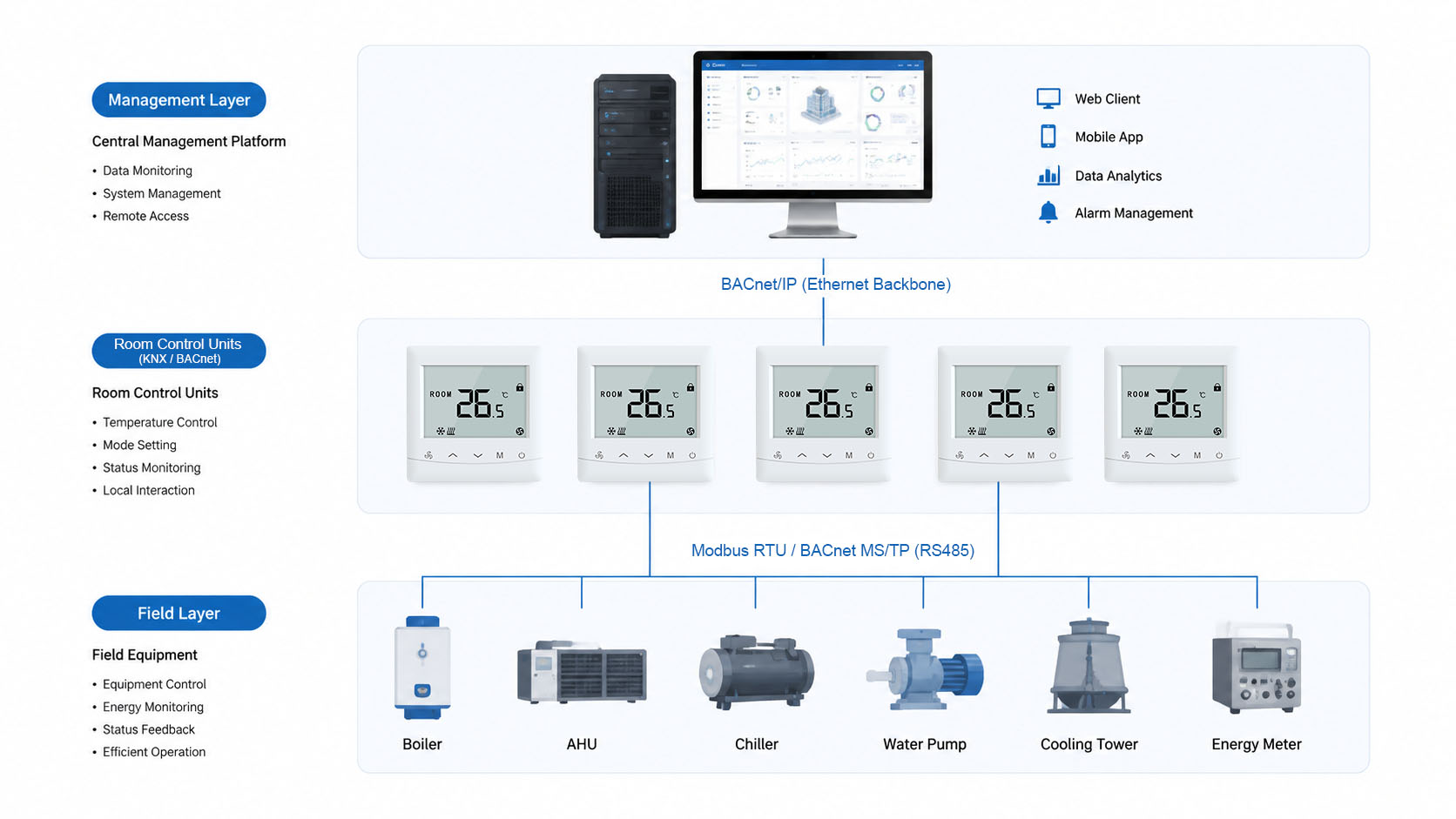
In practice, BACnet handles the high-level server network. KNX runs the individual room thermostats, and Modbus polls the power meters. The main BMS translates those KNX and Modbus points straight into BACnet objects. You get a unified dashboard without sacrificing field performance.
5. Side-by-Side Comparison
| Feature | BACnet | Modbus | KNX |
|---|---|---|---|
| Best Used For | Main network backbone and central HVAC. | Field gear: meters, chillers, boilers. | Room control: thermostats, lighting, blinds. |
| Architecture | Client-Server setup. | Client-Server (Master-Slave). | Decentralized peer-to-peer. |
| Data Model | Standardized objects and services. | Raw registers and coils. | Group objects built via ETS tool. |
| Security Level | Needs BACnet/SC upgrade. | None (Standard). | High (KNX Secure AES-128). |
6. Get Your OEM Controllers from E-TOP
Bidding on commercial jobs requires controllers that support these open languages natively. We focus purely on B2B OEM/ODM manufacturing. Need thermostats that natively support BACnet MS/TP, Modbus RTU, or KNX? E-TOP supplies the field-proven hardware you need to win those bids.

Frequently Asked Questions (FAQs)
Q1: Can BACnet and KNX run on the same job?
A: Absolutely. They complement each other well. KNX handles room thermostats and scene keypads locally, while BACnet handles supervisor functions. A basic protocol gateway bridges the two easily.
Q2: Why is Modbus still around after all these years?
A: It's cheap, dirt-simple, and supported by almost everything. Nearly every modern energy meter, variable frequency drive, or commercial pump still ships with Modbus built in.
Q3: How secure are these protocols?
A: KNX takes the lead here; "KNX Secure" uses robust AES-128 encryption. Standard Modbus and older BACnet setups lack native encryption, though the industry is now rapidly adopting BACnet/SC (Secure Connect) to encrypt central network traffic.